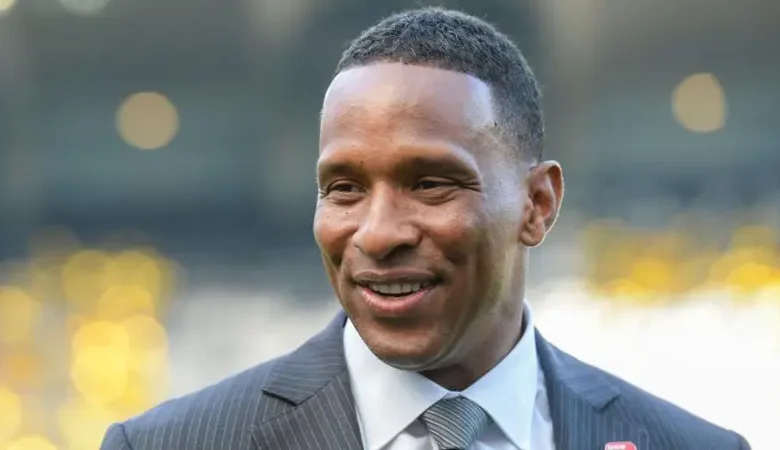
Former Premier League goalkeeper Shaka Hislop has said it is “alarming” that tests for prostate cancer are not “regular and standardised” in the United Kingdom.
The 56-year-old was diagnosed with the disease in 2024 after he requested a prostate-specific antigen (PSA) blood test during his annual medical examination in the United States.
Routine PSA testing is not offered by the National Health Service in the United Kingdom, with the screening usually only provided if you are over 50 or if other symptoms are identified.
According to research from Prostate Cancer UK, one in eight males will be diagnosed with the disease at some point in their life.
In black males, meanwhile, that risk is as high as one in four.
The former Trinidad and Tobago keeper – who now lives in the United States – believes the current testing protocol for the disease is flawed and needs changing, especially with cancer’s rising prominence in certain ethnic communities.
Speaking to BBC Radio 5 Live’s Breakfast programme, Hislop said: “I honestly can’t believe that it is still a thing given all we know of prostate cancer and its prominence, particularly in the minority community.
“So, to have that not be a regular and standardised test as offered to people regardless of whether they have any family history or not, I find alarming.
“I have no history of prostate cancer in my family yet here I am having been diagnosed and been treated for it.”
Since his diagnosis, Hislop has tried to approach the prostate cancer with the same “fight” he had during a professional career that spanned six clubs in England, including West Ham and Newcastle.
But it has been difficult for his wife to deal with because of an “emotional history” with the disease.
“My father‑in‑law died of prostate cancer, so I can’t imagine what my wife was going through when she heard my news, knowing her emotional history with prostate cancer, having to deal with that and still be strong for me,” said Hislop.
“For me, it was slightly different in that I understand why they say fight cancer, because that was the only emotion I felt: ‘All right, this is a fight.’ And that’s exactly the way I saw it.
“This was me against cancer – or me and a surgical team against cancer. That was my mindset. I never felt beaten, I never felt demoralised. I never felt sorry. This was just another fight in my life.
“Much the same way I kind of approached a football game, where you focus solely on that.
“It’s the only thing that mattered and that was my entire mindset throughout.
“I know from speaking to people who’ve been diagnosed with prostate cancer that the initial emotional gut punch is tough.
“But I processed it differently. I just felt that this was a fight. Here we go. Let’s, you know, put the gloves on and have a go at this.”