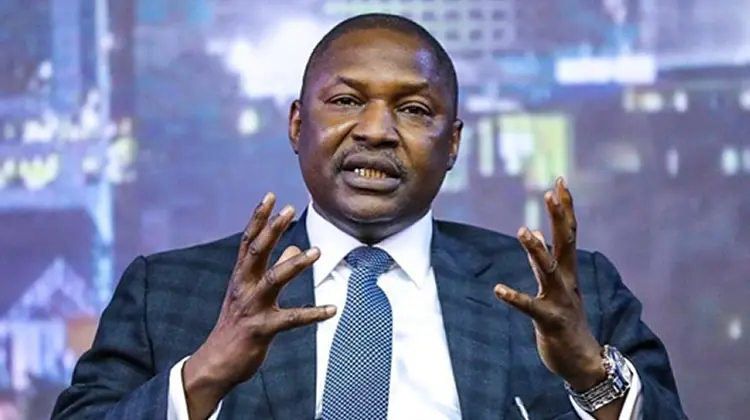
Former Attorney-General of the Federation and Minister of Justice, Abubakar Malami (SAN, has given clarifications on why he continues to be in detention by the Economic and Financial Crimes Commission (EFCC), despite voluntarily reporting to the agency on Monday.
Malami is being interrogated over many issues, including allegations relating to terrorism financing, the ownership of 46 bank accounts, the engagement of multiple legal representatives in the recovery of the $322.5 million Abacha loot, and the utilisation of funds released under the conditional cash transfer programme.
Malami said that he was detained without being given any specific reason other than being told that his earlier administrative bail had been revoked, despite not breaching the bail terms.
In a statement by his Special Assistant on Media, Mohammed Bello Doka, Malami said that he had been given new bail conditions, which he is ready to meet once the EFCC authorises him to do so.
Malami rebuffed allegations of terrorism financing and ownership of 46 bank accounts, saying they are “false, misleading and baseless.”
According to the statement, “We state without equivocation that there is no allegation, investigation or charge of terrorism financing against Abubakar Malami, SAN, by the Economic and Financial Crimes Commission (EFCC) or by any other security, intelligence or law-enforcement agency, whether in Nigeria or abroad.”
He said that claims suggesting that Mr Malami operates or controls “46 bank accounts” are “entirely fictitious, unsupported by facts, official records or lawful findings, and merely form part of a coordinated media trial aimed at character assassination.”
Doka noted that during Malami’s tenure as Attorney-General, he played a leading role in strengthening Nigeria’s AML/CFT framework, including the establishment of an independent NFIU; the enactment of the Money Laundering (Prevention and Prohibition) Act, 2022; and the Terrorism (Prevention and Prohibition) Act, 2022, reforms instrumental to Nigeria’s eventual removal from the FATF grey list.
Doka said that the Buhari administration rejected the initial terms presented by Swiss lawyer Enrico Monfrini, who reportedly requested a $5 million upfront fee and a success fee of up to 40 percent, while addressing allegations of duplicated legal representation in the recovery of the Abacha loot.
Doka saud that the Abacha loot was repatriated in tranches and used strictly in line with tripartite agreements with international partners. These included the 2017–2018 $322 million from Switzerland disbursed through the National Social Investment Programme under World Bank and civil society monitoring, and the $321 million repatriated from Jersey in 2020, which was channelled into major infrastructure projects such as the Lagos–Ibadan Expressway, Abuja–Kano Road and the Second Niger Bridge.
Malami said he received an EFCC invitation, pledging on Facebook to honour it as “a law-abiding and patriotic citizen.”